Art Basel Miami Beach
 Opening Day (by invitation only): December 5, 2012, 11am – 9pm
Public Show Days
Thursday, Dec 6 to Saturday, Dec 8, 12noon to 8pm
Sunday, Dec 9, 2012, 12noon to 6pm
Miami Beach Convention Center
1901 Convention Center Drive
Miami Beach, FL 33139
Website
Admission:
One-Day Ticket $42
Permanent Pass $90
Evening Ticket (valid from 4 pm) $29
Reduced One-Day Ticket (Students with ID, Senior Citizens aged 62 and above, Groups of 10 or more) $24
School Group (through grade 12 with accompanying chaperone per group of 10) $10
Free admission for children under 16 when accompanied by an adult.
This year’s edition of Art Basel Miami Beach will feature 257 leading international galleries, with work ranging from the Modern period of the early 20th century to the most contemporary. Application numbers have again been high, exceeding those for 2011, with more than 680 galleries competing to participate. Taking place at the Miami Beach Convention Center from December 6 to December 9, 2012, the show, whose main sponsor is UBS, will present a geographically diverse selection of galleries from 31 countries across five continents.
Roughly 50 percent of the galleries come from the United States and Latin America. Exhibiting galleries include 99 from the United States; 34 from Germany; 18 from France; 19 from Great Britain; 14 from Brazil; 11 from Italy; 10 from Switzerland; 9 each from Spain; 4 each from Austria, Belgium and Mexico; 3 each from Argentina and China; 2 each from Canada, Colombia, Denmark, Japan, Portugal, Turkey and South Africa; 1 each from Greece, Ireland, Israel, India, Iceland, Korea, Norway, Peru, Russia, Sweden and Uruguay.
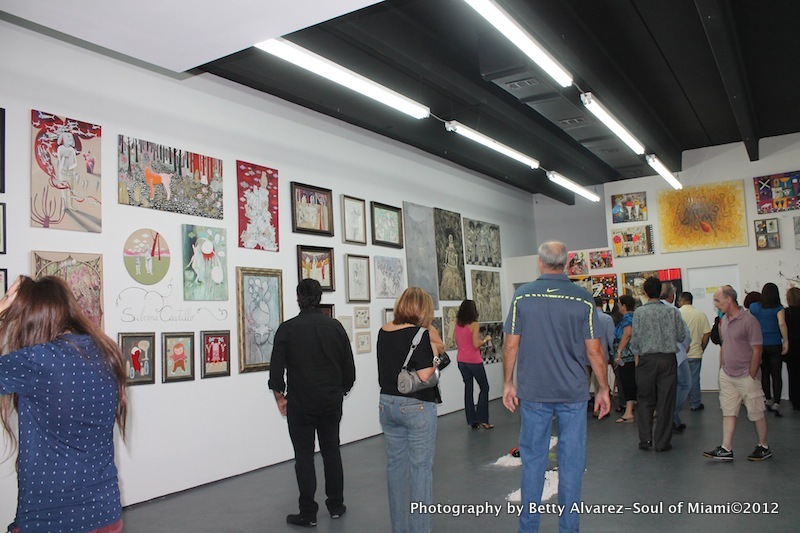
Art Galleries, the main sector of Art Basel’s Miami Beach show, will feature 201 exhibitors. This year’s selection brings a strong showing of Modern material, further underlining the historical dimension of Art Basel Miami Beach. Joining a notable number of returning galleries, the sector includes many participants exhibiting at the show after a brief hiatus – Art: Concept, Konrad Fischer Galerie, Galeria Graça Brandão, Bernard Jacobson Gallery, Kewenig Galerie, Anthony Reynolds Gallery, Esther Schipper and Galerie Daniel Templon – joined by several first-time exhibitors Henrique Faria Fine Art, Galerie Michael Haas, Hammer Galleries, Hirschl & Adler Modern, Galerie Mehdi Chouakri, Craig F. Starr Gallery and Tornabuoni Art. For a full list of exhibitors participating in the Art Galleries sector, please visit www.artbasel.com/galleries.
Art Nova offers younger galleries a platform to present artworks made in the last three years by two or three artists. Since its inception, the Art Nova sector has become known as a space of discovery for works fresh from the studio. With 40 galleries on display, the sector will feature work by more than 100 artists from across the world including juxtapositions such as: Yael Bartana, Tal R. and Tom Burr (Sommer Contemporary Art); Tania Pérez Cordova and Nina Beier (Proyectos Monclova); Becky Beasley and Simon Dybbroe Möller (Francesca Minini); Theaster Gates and Angel Otero (Kavi Gupta Gallery); John Gerrard, Michelle Lopez and Hans Schabus (Simon Preston Gallery); Brigida Baltar, Lucia Koch and Melanie Smith (Galeria Nara Roesler); Julião Sarmento and Leigh Ledare (Pilar Corrias); Dove Allouche, Jonathan Binet and Jessica Warboys (Gaudel de Stampa); and Hao Liang, Yangjiang Group and Zheng Guogu (Vitamin Creative Space). For a full list of galleries and the artists they will show, please visit www.artbasel.com/nova.
Presenting a diverse range of projects by a single artist, Art Positions features a tight selection of 16 galleries, 12 of which did not exhibit at Art Basel in Miami Beach last year. An exciting platform for collectors, museum directors, critics and art enthusiasts to gain further insight into the work of individual emerging artists, this year’s presentation will feature many exciting young artists working internationally today: Matt Keegan (Altman Siegel Gallery SF), Pablo Rasgado (Arratia, Beer), Nathan Peter (PSM), Leyla Cárdenas, (GalerÃa Casas Riegner), Colby Bird (Fitzroy Gallery), Christian Flamm, (Galeria Fonti), Felipe Arturo (La Central), Irene Kopelman (Labor), Paulo Vivacqua (Galeria Laura Marsiaj), Julieta Aranda, (Galerie mor.charpentier), Atsushi Kaga (Mother’s Tankstation), Asli Cavusoglu (NON Gallery), Ivan Seal (RaebervonStenglin), Andra Ursuta (Ramiken Crucible), Latoya Ruby Frazier (Galerie Michel Rein), and Agustina Woodgate (Spinello Projects).
Select galleries participating in these three sectors of the Miami Beach edition of Art Basel will present further work at Art Kabinett, Art Video and Art Public. As part of Art Kabinett, select galleries admitted to the Art Galleries sector will present curated exhibitions in separately delineated spaces within their booths. The curatorial concepts for Art Kabinett are diverse, including thematic group exhibitions, art-historical showcases and solo shows for rising artists. As part of Art Video galleries will present works by some of the most exciting artists working in the media today. Organized in association with London’s Artprojx, screenings of Art Video will be presented in two different locations: in SoundScape Park on the 7,000-square-foot outdoor projection wall of the New World Centre, designed by renowned architect Frank Gehry, and within five viewing pods inside the Miami Beach Convention Center. Art Public will turn Collins Park into a public outdoor exhibition space with large-scale sculptures and performances. Curated by Christine Y. Kim, Associate Curator of Contemporary Art at Los Angeles County Museum of Art (LACMA) and co-founder of the Los Angeles Nomadic Division (LAND), this sector is produced in collaboration with the Bass Museum of Art. Further information on these sectors will be released in the coming months.
The gallery presentations will be accompanied by an engaging program of talks and panel discussions as part of Art Basel Conversations and Art Salon, offering audiences access to first-hand information on the main aspects of the international art world and market. Further details on Art Basel Conversations, Art Salon and Art Film will be released in the coming months.
Entering its second decade in Miami Beach, Art Basel week will spotlight museums and private collections in Miami Beach putting on their strongest exhibitions of the year. Miami’s leading private collections – among them the Cisneros Fontanals Art Foundation (CIFO), the De la Cruz Collection Contemporary Art Space, The Margulies Collection at the Warehouse, the Rubell Family Collection and World Class Boxing – will be opening their exhibition spaces to guests of the international art show. The museums of South Florida will be staging important exhibitions to coincide with Art Basel Miami Beach, including: ‘New Work Miami 2013’ at the Miami Art Museum; ‘The Endless Renaissance – Six Solo Artist Projects: Eija-Liisa Ahtila, Barry X Ball, Walead Beshty, Hans-Peter Feldmann, Ged Quinn, Araya Rasdjarmrearnsook’ at the Bass Museum of Art; ‘Bill Viola: Liber Insularum’ at the Museum of Contemporary Art (MOCA), North Miami; ‘2012 Rudin Prize for Emerging Photographers’ and ‘Sylvia Plimack Mangold: Landscape and Trees’ at the Norton Museum and ‘Postcards of the Wiener Werkstätte: Selections from the Leonard A. Lauder Collection’ and ‘Esther Shalev-Gerz: Describing Labor’ at the Wolfsonian-FIU.
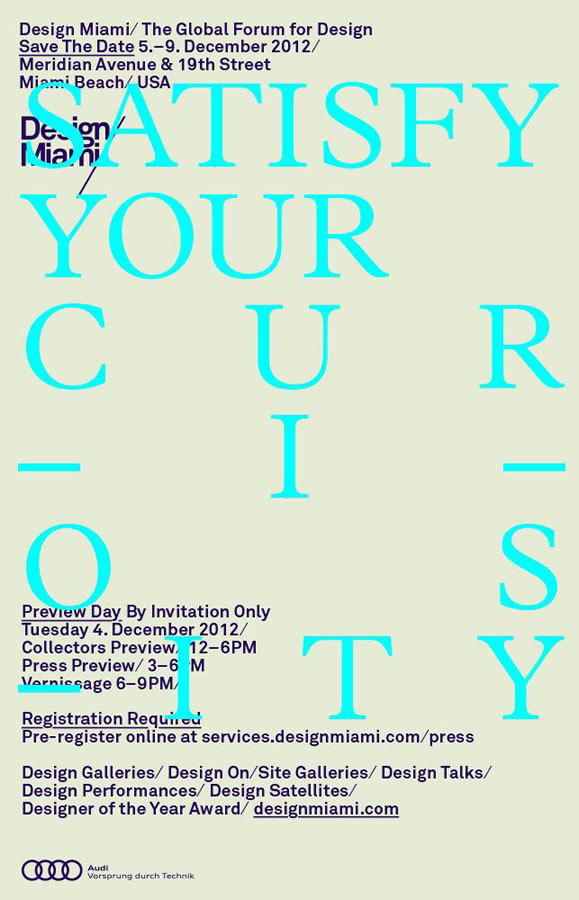
This year marks the eighth edition of Design Miami/, from December 5 to December 9, 2012, with the world’s most prominent design galleries presenting contemporary and historic work. Design Miami/ will again be located alongside the Miami Beach Convention Center. For further information please visit www.designmiami.com.
Art Basel stages the world’s premier art shows for Modern and contemporary works, sited in Basel, Hong Kong, and Miami Beach. Defined by its host city and region, each show is unique, which is reflected in its participating galleries, artworks presented, and the content of parallel programming produced in collaboration with local institutions for each edition. In addition to ambitious stands featuring leading galleries from around the globe, each show’s singular exhibition sectors spotlight the latest developments in the visual arts, offering visitors new ideas, new inspiration and new contacts in the art world. The first edition of Art Basel in Hong Kong will take place at the Hong Kong Convention and Exhibition Centre (HKCEC), May 23 – 26, 2013. The 44th edition of Art Basel in Basel, Switzerland will take place June 13 – 16, 2013.
UBS continues its longstanding and successful partnership with Art Basel and Art Basel Miami Beach in 2012. The firm has been the main sponsor of Art Basel for the past 18 years and main sponsor of Art Basel in Miami Beach since the show’s inception in 2002. UBS has a rich history of actively supporting cultural and artistic endeavors across the world, with a focus on promotion, collection and educational activities in the world of contemporary art.
NetJets continues their valued partnership with the Miami Beach edition of Art Basel. They are joined by Davidoff, the prestigious Swiss cigar brand, and Absolut Art Bureau, responsible for The Absolut Company’s international art initiatives, on Associate Sponsor level. Furniture will be provided by Herman Miller and the VIP car service will be by BMW. The show is supported by the Miami Beach Visitor and Convention Authority. The official Media Partners are The Financial Times and The Miami Herald. Additional partners can be found at www.artbasel.com/partners.
Guided Tours
AXA Art, the globally active specialty art and collectibles insurance company, will again provide VIP guided tours at Art Basel in Miami Beach. Reservations can be made until November 16. For reservations and information contact Amanda Rowley: axaartcommunications@axa-art-usa.com.
The ArtNexus guided tours in English and Spanish will be available daily during show hours from Thursday to Sunday. There will be general tours of the show and special tours for Art Kabinett. For reservations and information contact Sol Romero: Tel. +1 305 891 7270, ext. 4; tours@artnexus.com. During show days, reservations can be made by phone or at the Guided Tours Information Desk in Info Zone D.
The Bass Museum of Art will offer guided group and private tours of Art Public and the Bass Museum in English. Walk-in tours (no reservation required) will take place at 10:30am, 11:30am, and 12:30pm, each day of the show. Each tour will take 45 minutes. Price: $8 per person, groups of 15 or more $5 per person. School group tours are available in English and will take 45 minutes. Price: $4 per child (free for accompanying teachers and parents).Private and group tours to be booked in advance. For reservations and further information, contact the Bass Museum of Art, Kylee Crook: Tel. +1 305 673 7530, ext. 9-1001; artpublic_tours@bassmuseum.org .